The warmest comforter for your bed is the one whose fill weight matches your bedroom’s overnight temperature — not the thickest one on the shelf. Warmth comes from how much down is inside and how well the construction holds it in place, and a comforter that overshoots your room is as uncomfortable as one that falls short. Measuring the room once tells you more than any seasonal buying guide.
That measurement is the step almost everyone skips, and it is free.
Warmth is fill weight, not thickness
Two numbers decide how warm a down comforter is, and they are often confused.
Fill power is the volume one ounce of down occupies when it expands freely. It grades the loft of the down. Fill weight is the actual mass of down inside the comforter, and that is what sets the warmth. High fill power with a light fill weight gives you a light comforter made of good down — which is excellent, and not warm. Anyone shopping for the warmest comforter should therefore compare warmth tiers within one product line, where the down is identical and only the quantity changes, rather than comparing fill power figures across brands.
Construction is the third factor and the easiest to inspect. Sewn-through comforters are stitched straight through both faces, leaving a cold line with no insulation at every seam. Baffle-box construction uses internal fabric walls so the down fills three-dimensional chambers and keeps full height right to the stitching. At identical fill weight, baffle box sleeps warmer and more evenly.
Start with the room, not the calendar
Put a thermometer on the nightstand and read it in the morning before the heating comes on. That number is your input.
A bedroom that settles at 60 to 64°F overnight supports a substantial fill weight, and will need it for most of the year rather than three months. A bedroom holding 68 to 72°F does not, even in January — and people in that situation routinely buy heavy winter bedding, overheat, and conclude that down does not suit them. Below about 58°F the comforter stops being the main variable and draughts or insulation become the thing worth fixing.
Two adjustments. If two people share the bed, drop one warmth tier from what either would choose alone, because two bodies under one comforter generate considerably more heat than one. And if you run cold at the extremities but warm at the core, that is usually circulation rather than insufficient insulation, and more fill will not fix it.
There is an asymmetry worth internalising: you can always add a layer over a comforter that runs slightly cool, but you cannot take insulation out of one that runs too warm. When uncertain, choose the lighter tier.
Which material is actually warmest
For a given fill weight, down is the warmest common bedding fill, because it traps more air per unit of mass than wool or polyester and recovers its loft after compression.
Wool is heavier for the same warmth but buffers moisture better, which some people prefer. Polyester fill is the cheapest and the least warm per unit of weight, and it compresses permanently over time, which is why a synthetic comforter that felt warm in year one often does not in year three.
Shoppers looking for the softest warmest comforter are really asking two questions at once, and they have separate answers: softness comes from the shell, warmth from the fill weight. The shell is a separate question and does not change the insulation. A cotton or linen-blend shell will feel cooler on first contact than a dense synthetic one at identical fill, because natural fibres move moisture away from skin instead of holding it there — but the warmth number has not changed. So when the question is warmest comforter material, the honest answer separates fill from shell: choose down for the fill, then choose the shell by how you like fabric to feel. Comparing the tiers across one warmest comforter material range makes that separation visible, because the shell varies while the warmth tiers stay labelled the same way.
One worked example
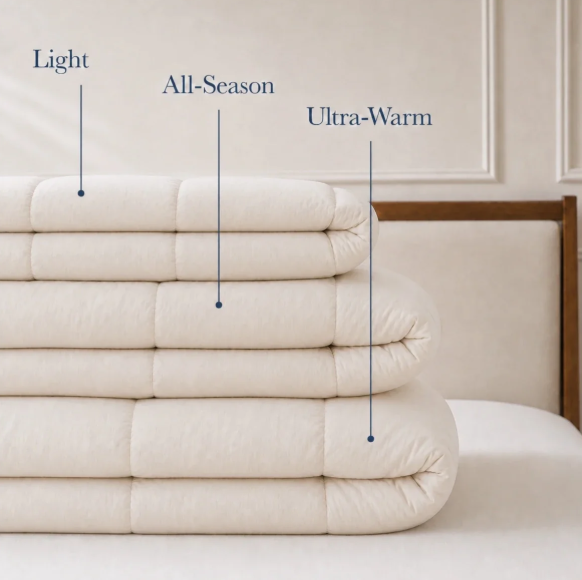
It helps to look at one product where the tier is the only thing that changes. A reversible organic cotton goose down comforter comes in all three warmth levels with the same shell and construction, so fill weight is the only variable.
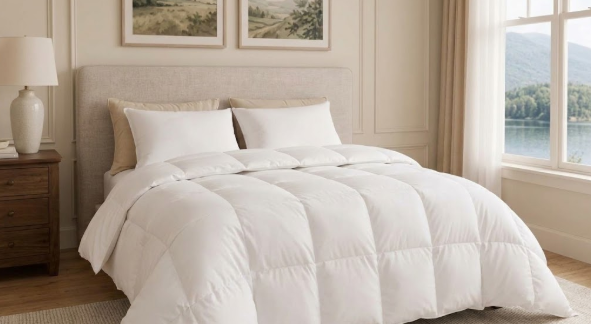
The Organic Cotton Reversible Goose Down Comforter — Limited Edition has an organic cotton shell with a gently textured matte finish and relaxed natural creases, filled with goose down. It is reversible, carrying a botanical colour on one face and a coordinating ivory on the reverse, in two colourways: Lavender Bloom and Sage Bloom. It is made in three warmth levels — Light, All Season and Ultra Warm — and three sizes: Twin at 68 × 86 in (172.7 × 218.4 cm), Queen / Full at 90 × 90 in (228.6 × 228.6 cm) and King / Cal King at 107 × 90 in (271.8 × 228.6 cm), with every size available in both colourways and all three warmth levels.
One comforter is included; the styling accessories shown in the photography are sold separately. Care follows the attached label, using a large-capacity washer with a gentle or down detergent and no fabric softener. It ships free with a tracking number sent on confirmation, and carries a 30-day return request window from delivery, with a free return label on eligible standard returns once approved.
The Organic Cotton Reversible Goose Down Comforter — Limited Edition publishes warmth tier, shell fibre, sizes and care, and does not publish a fill power or fill weight figure. That is worth stating plainly rather than glossing: where those two numbers are absent, the warmth tier and your own room measurement are what you have to work from, and the returns window becomes your real test. A reader who wants to compare on fill power needs a product line that publishes it.
For context, the same brand’s cotton-shelled comforter publishes 650 fill power with an all-season fill weight of 25 ounces in Twin, 38 ounces in Queen and 44 ounces in King, and carries Responsible Down Standard (RDS) and OEKO-TEX® STANDARD 100. Responsible Down Standard (RDS) audits the down supply chain for bird welfare, including prohibitions on live-plucking and force-feeding. OEKO-TEX® STANDARD 100 certifies that the finished textile has been tested against a list of substances harmful to human health. The two claims cover different things and neither implies the other.
Storing the one you are replacing
Most of the damage to down happens in spring, not autumn.
Wash or thoroughly air the comforter before storing it, because body oils left in the fill attract pests and degrade the down over a season. If you wash it, dry it completely — down can feel dry at the surface while the core is still damp, and damp down mildews in storage and loses loft permanently. Dry it longer than seems necessary and shake it periodically to break up clumps.
Then store it loose and breathing, in a large breathable cotton bag in a cool dry place. Vacuum-compression bags are convenient and they crush the clusters that create loft, with some of that loss never recovering.
The short version
Measure the bedroom overnight before buying anything. Choose the warmth tier from that number, dropped one level if two of you share the bed. Compare tiers inside one product line rather than fill power across brands. Prefer baffle-box construction. Err lighter, because a layer fixes too-cool and nothing fixes too-warm. Store the old one clean, bone dry and uncompressed.
FAQ
What is the warmest down comforter?
The warmest down comforter is the one with the highest fill weight in a baffle-box construction, usually sold as an ultra-warm or winter tier. Fill power grades the down’s loft rather than total warmth, so compare warmth tiers within a single product line where the down is identical and only the quantity changes. Match the tier to your bedroom’s overnight temperature.
What comforter is best for extreme winter conditions?
For a bedroom that stays below about 60°F overnight, choose the heaviest fill weight available in baffle-box construction, with a natural-fibre shell so moisture still escapes. Down outperforms wool and polyester per unit of weight and recovers loft after compression. If the room is below 58°F, address draughts and insulation too, since bedding alone cannot compensate.
What type of bedding is best for staying warm in the winter?
A high-fill-weight down comforter in baffle-box construction does most of the work, because trapped air rather than fabric thickness provides insulation. Add a breathable natural-fibre shell so body moisture escapes instead of condensing and making the warmth feel clammy. A layered approach beats one very heavy item, since layers can be removed as the room changes.